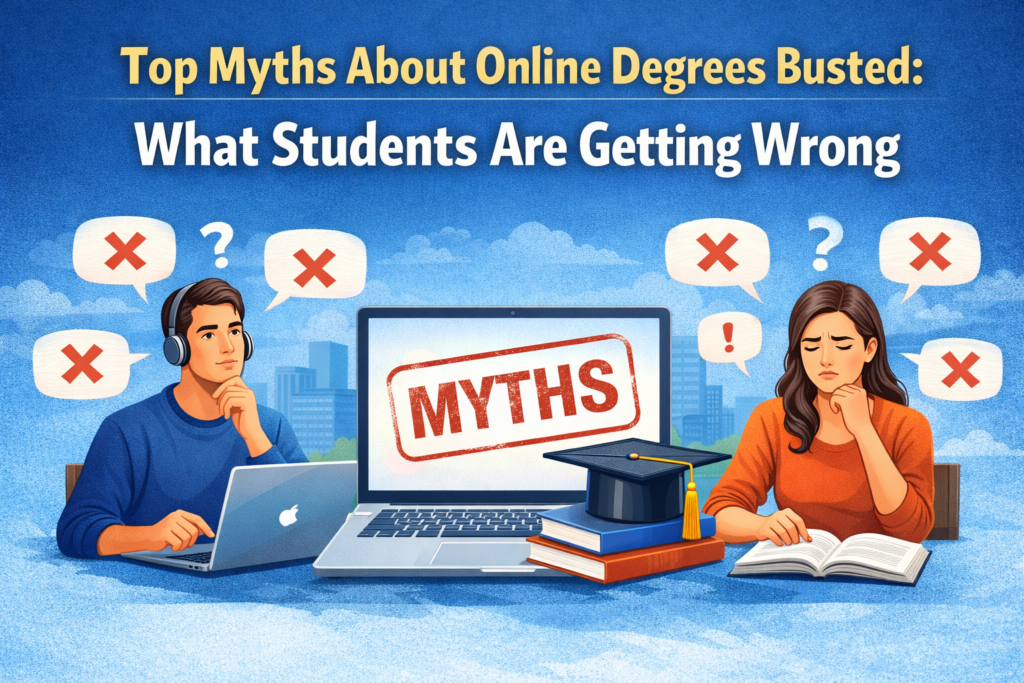
Top Myths About Online Degrees Busted: What Students Are Getting Wrong
According to the UGC-DEB enrolment study, India has never seen more students choosing online degrees than it does today. The number is rising every year, and it’s not just because classes are convenient. Learners now want mobility, flexibility, and the freedom to study without disrupting their jobs or personal commitments.
However, even with this shift, online education still carries a surprising amount of confusion. Outdated online degree misconceptions about credibility, difficulty level, or job prospects keep many students from exploring what is actually a highly structured and accredited mode of learning. With universities investing heavily in digital classrooms and support systems, it’s the perfect time to break down these myths and see the real picture.
Myth 1: Online Courses Have No Job Market Value
One of the most common myths is the assumption that online programmes are weak substitutes for traditional degrees. This belief usually comes from the existence of a few non-accredited platforms that do not follow academic quality standards. However, the bigger picture says otherwise. Many reputed online degree universities in India and abroad now offer structured, rigorously evaluated digital programmes approved by national and regional accrediting bodies.
Employers increasingly understand that learners often juggle jobs, families, and personal responsibilities, making flexible education not just pragmatic but highly necessary. Modern recruiters pay a lot more attention to the skills, performance, and exposure an individual has acquired, rather than where the classroom was, whether it was physical or virtual. Graduates from credible institutions consistently prove that online formats can deliver strong academic foundations and industry-ready skills.
Myth 2: Online Degrees Are Easier
One such online degree misconception is that online learning is an easy way out. Instead, the academic expectations are mostly identical to those in regular classroom settings. The curriculum, assessment methods, learning outcomes, and credit systems of these courses come under the purview of bodies like UGC-DEB; hence, parity across modes of learning becomes assured.
It does, however, call for self-discipline, time management, and active participation on the part of the learner. Students are expected to engage in discussions, complete assignments, show up for virtual classes, and hit each weekly deadline. While this format does have its degree of flexibility, it requires an even greater degree of responsibility because learners have fewer real-time reminders and must track their progress proactively. Far from easier, online learning often builds some essential workplace skills: independence, adaptability, and consistency.
Myth 3: You Will Feel Completely Isolated
Online learning today is far from mere modules of self-study. Today, online degree universities in India use collaborative digital platforms that promote peer interaction, community building, and academic support. Live classes, breakout rooms, project groups, digital library access, and moderated forums help students stay connected.
Most platforms encourage direct interaction with instructors through one-on-one sessions, live Q&A, or scheduled doubt-clearing interactions. While that may not replace the feel of a crowded classroom, a number of learners love the customized and focused nature of virtual collaboration. The structure enables students to network across cities and, in some cases, across countries, building a more diverse learning community.
Myth 4: Online Learning Lacks Instructor Interaction
Contrary to belief, digital education does not restrict access to faculty members. Many instructors are more reachable online than they ever were in traditional lecture halls. Today, universities use LMS dashboards, messaging systems, live classes, and discussion boards to provide ongoing guidance for their students.
The virtual mode often removes the barrier of hesitation. Students who normally would not raise a hand in a crowded class will find it a lot easier to type a question or schedule a one-on-one session. Indeed, some educators even conduct personalized tutorials to bridge the distance and maintain high engagement throughout the semester.
Myth 5: Understanding Concepts Is Entirely Your Responsibility
Students are often misinformed that an online degree will leave them to their own devices. Actually, the fact is quite the reverse. Reputed institutions offer live classes, recorded lectures, digital notes, mentorship sessions, and academic counselling. Many universities, including IGNOU, CU, NMIMS, and others, provide structured support designed specifically for remote learners.
Further, the digital ecosystem allows endless learning tools outside the university: MOOCs, explainers, virtual labs, and academic communities. In this information-rich age, help is a click away, so students need never struggle with tricky concepts.
Myth 6: Networking Isn’t Possible in Distance or Online Mode
The idea that networking is limited to physical campuses is outdated. Virtual education actually expands networking possibilities. Students interact with diverse learners from different industries, cities, and even countries. Virtual job fairs, alumni meets, discussion groups, and LinkedIn-based communities help learners connect beyond geographical boundaries.
Working professionals enrolled in online programmes often benefit the most; they can apply concepts immediately at work and form meaningful relationships with peers who share similar career goals.
Myth 7: You Cannot Get a Good Job with a Distance or Online Qualification
This is one of the biggest online degree misconceptions that has prevailed for years, but policy-level updates have changed the landscape significantly. UGC has officially recognised online and distance degrees from approved universities as equivalent to regular degrees. This ensures that learners face no restrictions in employment, higher studies, or competitive exams.
Perception has also shifted in the industry, particularly post-pandemic, where learning had to be through remote modalities. Today, employers also emphasize demonstrable skills, adaptability, and a continuous learning mindset fostered very strongly through digital education. As long as students choose a credible, accredited institution, opportunities remain strong and online degree recognition for jobs continues to grow across sectors.
Learn with Confidence through Skill2Work
Choosing the perfect online degree is very easy when you have the right team to guide you. At Skill2Work, we ease your entire admission journey with personalized support and a dedicated mentor who will walk with you right through to securing your seat. Our objective is to make clear, hassle-free, and fully aligned online education decisions for your career.
With Skill2Work, you get:
- A personal admission mentor up to enrollment
- Guidance pertaining to universities approved by the UGC
- Helps in course selection and eligibility
- Timely updates and transparent support
Take the First Step, Skill2Work Will Handle the Rest
Online learning is no longer an alternative; rather, it has become a credible, progressive, and strategically smart choice for learners who seek flexibility without compromising on quality. With the growth of digital education further, a majority of learners are still skeptical about course selection, eligibility, or how to handle the admission process. Skill2Work helps students make this experience comprehensible, effortless, and personalized. Be it knowing about the UGC-approved programs or shortlisting suitable online degree universities in India, every learner is assured of getting reliable end-to-end support from our team.
Take the first step now and let Skill2Work guide you through personalized guidance so that you can unlock your future in education.
FAQs:
- Are online degrees valid in India?
Yes, online degrees from universities approved by UGC-DEB are valid for employment, higher studies, and government jobs/competitive exams.
- Do employers accept online degrees?
Most employers respect the skills and credibility of the institution, and hence, the acceptance of online programs is wide.
- In an online course, can I interact with any teacher?
Yes, through live classes, doubt sessions, emails, and one-on-one consultations.
- Can networking be done through online learning?
It goes without saying that virtual communities, alumni events, and project groups help with building strong networks.
- Are online degrees more affordable than regular programs?
Mostly, yes. They cut down on costs like accommodation, traveling, and campus fees.